
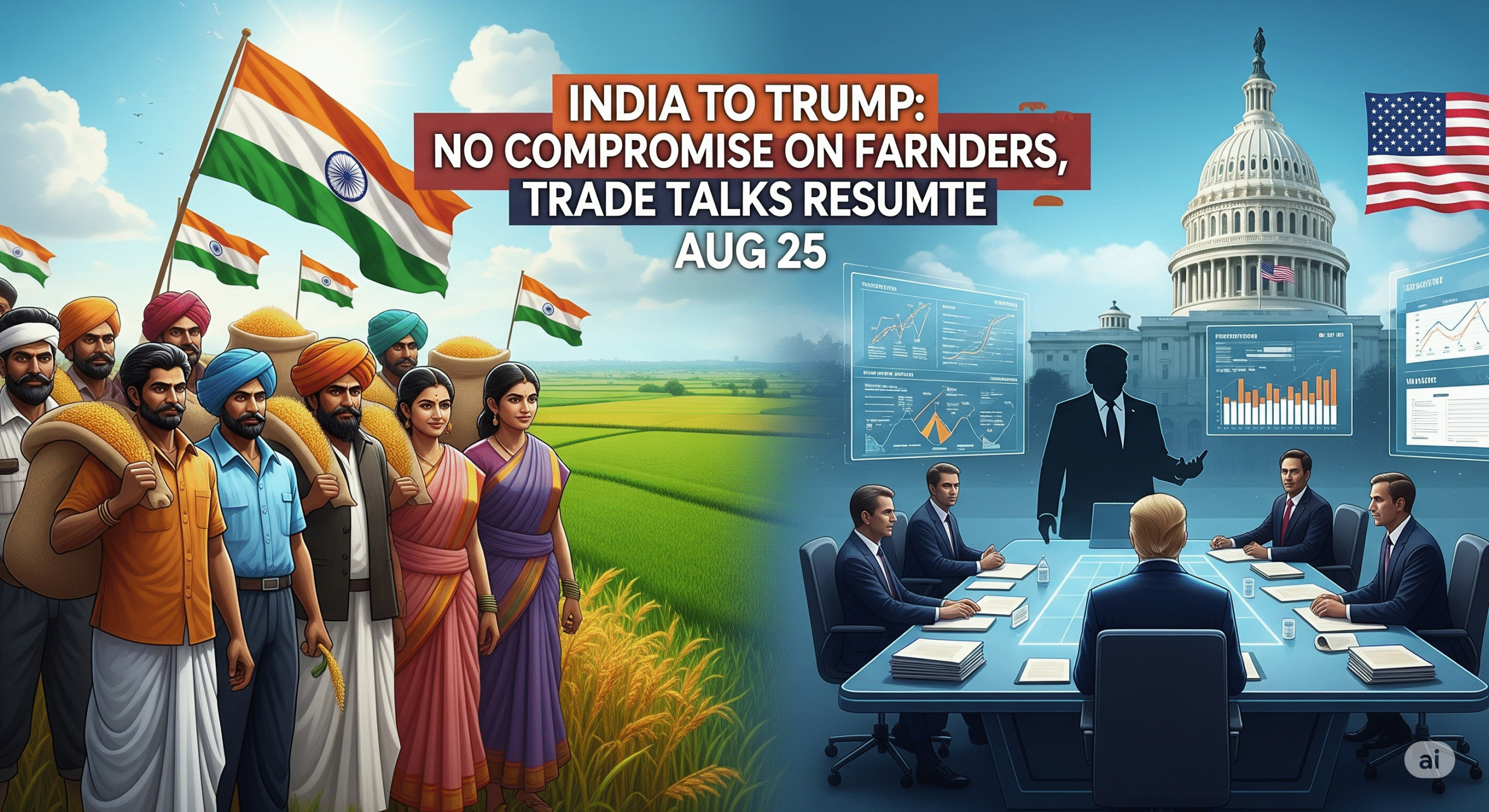
In the latest developments surrounding U.S.–India trade relations, India has made it unequivocally clear that it will not compromise on the interests of its farmers, even as trade talks are set to resume on August 25, 2025, following renewed tariff proposals from former U.S. President Donald Trump.
Amid Trump’s re-emergence on the global stage with promises of imposing aggressive tariffs on foreign imports, including those from India, New Delhi has responded with strategic caution and a bold stance—signaling that agricultural sovereignty and domestic welfare will not be traded away for diplomatic convenience.
Backdrop: Trump’s Tariff Threats Reignite Global Trade Tensions
Donald Trump, who is currently campaigning for another presidential term, has reignited his signature policy pitch: high tariffs on foreign imports to protect American industry. His latest statements have included the possibility of:
-
Raising tariffs on textiles, pharmaceuticals, and agricultural goods from countries like China and India
-
Introducing a universal baseline tariff on all imports
-
Reviewing past trade deals that he claims are “unfair to American workers”
This has raised concern in global trade circles, particularly in India, which remains a key exporter of generic medicines, basmati rice, textiles, and information technology services to the U.S.
India’s Response: No Compromise on Farmers’ Welfare
India’s Commerce and Industry Ministry responded swiftly, asserting:
“India will not compromise on the livelihoods of our farmers. Food and agriculture security are non-negotiable.”
Officials emphasized that while India remains open to fair and constructive trade talks, it will not:
-
Open domestic agricultural markets to unfair competition
-
Remove Minimum Support Prices (MSP) for crops under foreign pressure
-
Reduce import duties on sensitive items like dairy, wheat, or sugar
The response reflects a wider political sentiment in India, where farmers’ welfare is deeply linked to national identity and electoral politics—especially in light of the historic farmers’ protests that shook the nation in 2020–21.
What’s at Stake in the Aug 25 Trade Talks?
Set to take place in Washington, D.C., the upcoming dialogue will focus on:
-
Tariff rollbacks on select goods
-
Market access for American agricultural products
-
Intellectual property rights for pharmaceuticals
-
Renewable energy trade
-
WTO commitments and digital economy frameworks
While both sides have economic incentives to improve ties (India is the 9th largest trading partner of the U.S.), geopolitical realities—such as China’s growing influence—also make this a high-stakes negotiation.
Expert Reactions and Industry Buzz
🔹 Dr. Rajeev Ranjan, trade economist:
“India’s stance is rational. Agriculture supports nearly 50% of the population. Rapid liberalization without protection could be catastrophic.”
🔹 U.S.-India Business Council (USIBC):
Called for “balanced progress” that ensures mutual benefit without harming smallholder farmers.
🔹 Indian Exporters’ Association:
Urged the government to defend domestic industries, particularly small textile and dairy producers, which face stiff competition from U.S. agri-tech giants.
Conclusion: Balancing Sovereignty and Diplomacy
As the world watches, India is drawing a clear line between economic cooperation and exploitation. The message from New Delhi is firm: strategic autonomy and domestic welfare will guide its trade policy—not external pressure or rhetoric.
The August 25 talks are poised to be a litmus test for how democracies navigate protectionism and free trade in the age of populism.
India’s approach could serve as a model for other developing nations facing similar pressures from global powers.
FAQs
Q1: What exactly did Donald Trump propose regarding tariffs?
A: Trump suggested blanket tariff increases on imports, including from India, as part of his 2025 economic revival campaign, especially targeting countries he deems “unfair trading partners.”
Q2: Why is India refusing to compromise on farmers’ issues?
A: Agriculture is a key livelihood sector in India, and any changes to support prices, import duties, or subsidies could hurt millions of rural families and destabilize food security.
Q3: What is expected from the August 25 trade talks?
A: The talks aim to resolve outstanding trade barriers and avoid a full-scale tariff war. Both sides are expected to negotiate on agricultural access, IP rights, and digital trade.
Q4: Are Trump’s tariff proposals official U.S. policy?
A: No. While Trump remains a prominent political figure, current U.S. policy under President Biden is more focused on rebuilding global trade alliances. Trump’s influence will depend on the 2024 election outcome.