
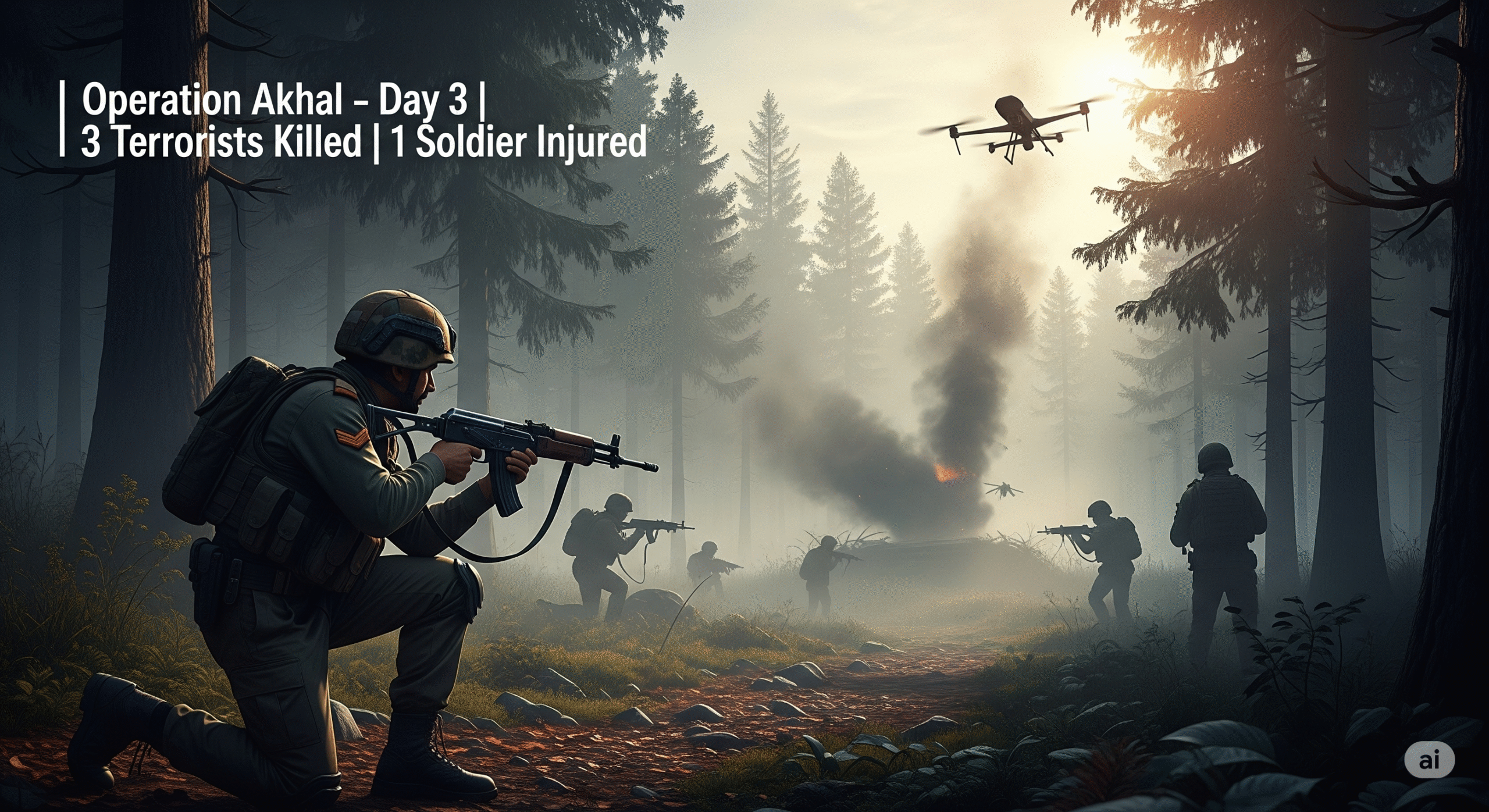
Amid growing concerns over a resurgence in cross-border militancy, Indian security forces have launched an aggressive counter-terror campaign titled “Operation Akhal” in Jammu and Kashmir. Now in its third day, the operation has already led to the elimination of three heavily armed terrorists, while one Indian Army soldier sustained injuries during the firefight.
Operation Akhal is seen as a significant step in India’s intensified anti-terror strategy following recent terrorist attacks in the Union Territory. The operation is underway in the Akhal forest region of Kulgam district, a known militant infiltration corridor close to the Line of Control (LoC).
Timeline of Events: What We Know So Far
🔸 Day 1 (August 1, 2025):
Security forces received intelligence inputs about a terrorist hideout in dense forest terrain. The area was swiftly cordoned off. An initial exchange of fire confirmed the presence of militants.
🔸 Day 2 (August 2):
Two terrorists were gunned down after a prolonged encounter that lasted over 10 hours. One soldier from the 34 Rashtriya Rifles was injured during the crossfire and airlifted for medical treatment.
🔸 Day 3 (August 3):
A third terrorist was neutralized after drone surveillance detected suspicious movement at dawn. Search and sanitization operations continue in the area to uncover potential bunkers or arms caches.
What Is Operation Akhal?
Operation Akhal is a joint mission spearheaded by the Indian Army, CRPF, and J&K Police, focused on flushing out militants entrenched in the Akhal forest region.
Key objectives include:
-
Neutralizing terror modules active in South Kashmir
-
Cutting off infiltration routes used by Pakistan-based groups
-
Seizing arms, explosives, and communication equipment
-
Preventing potential attacks on Amarnath pilgrims and security convoys
The operation is part of a broader counter-terror ramp-up following the June 2025 ambush on security personnel in Poonch, which left five jawans martyred.
Terrorists Identified: Links to Foreign Networks Suspected
Security officials have hinted that the neutralized terrorists may be affiliated with Lashkar-e-Taiba (LeT) or Jaish-e-Mohammed (JeM). Forensic analysis and interrogation of seized materials are underway to confirm their identities and possible cross-border affiliations.
Recovered items include:
-
AK-47 rifles with Pakistani markings
-
Satellite phones
-
High-altitude winter gear
-
Hand-drawn maps and coded notebooks
Local Security Heightened
Following Operation Akhal, checkpoints across Anantnag, Kulgam, and Pulwama have been reinforced. Schools near the encounter zone were temporarily shut, and mobile internet services have been restricted to prevent panic or misinformation.
Senior Army officers have assured that the region remains under full control, with efforts focused on preventing any retaliatory strikes or civilian harm.
Political & Public Response
The operation has drawn widespread attention:
-
Union Home Minister praised the security forces’ swift and decisive action.
-
J&K Lieutenant Governor Manoj Sinha assured continued focus on anti-terror missions.
-
Local residents, while anxious, have supported the army’s efforts to restore long-term peace.
FAQs
Q1: What is Operation Akhal?
A: Operation Akhal is a targeted counter-terror operation launched by Indian forces in Jammu and Kashmir’s Kulgam district to eliminate terrorist presence in the region.
Q2: How many terrorists have been killed so far?
A: As of Day 3, three terrorists have been confirmed killed in gunfights with security forces.
Q3: Are there civilian casualties?
A: No civilian casualties have been reported. The operation is being conducted with extreme caution to avoid collateral damage.
Q4: Is it safe to travel in the area now?
A: While operations are ongoing, authorities advise avoiding non-essential movement near the Akhal region until sanitization is complete.
Conclusion: A Renewed Push for Peace and Security
Operation Akhal represents a firm response to renewed terrorist threats in Jammu and Kashmir. With advanced surveillance tools, intelligence coordination, and high-altitude warfare training, Indian forces are showing their preparedness for asymmetrical warfare in challenging terrains.
The success of this operation will not only strengthen local peace but also send a powerful message to terror sponsors across the border: India’s resolve is unwavering, and every threat will be met with precision and strength.